Phone Guys: On The Go

It’s the third and final issue of this era of Young Men comics. We’ve seen the High-Gear Hot-Shots go from a group of kids who dreamed of the day they owned a car to a real hot-rod racing crew. Where do they go from there? Perhaps, dare I say, they become heroes?
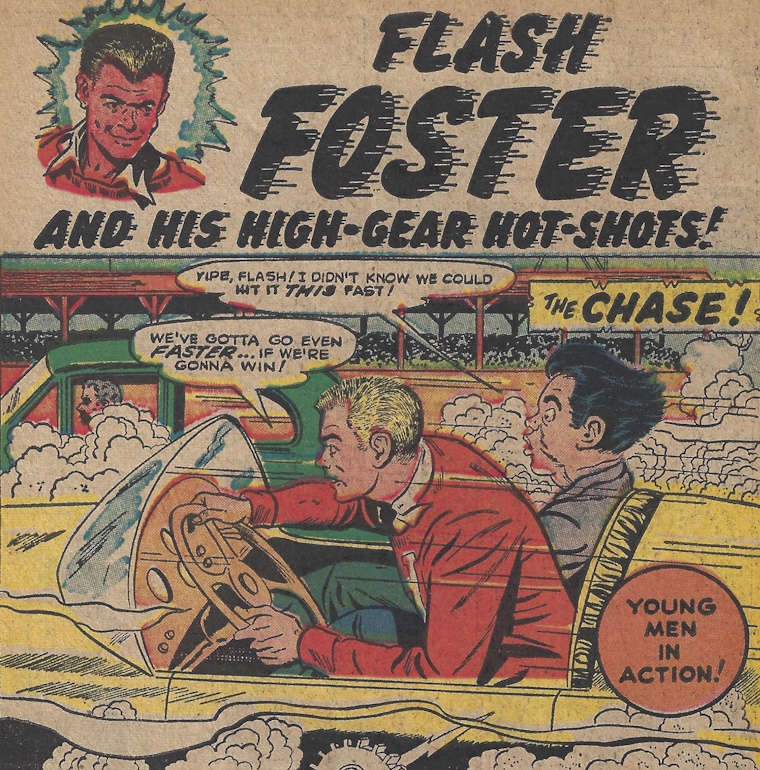
I’m impressed with the splash this time! It lives up to the promise of action more than the others did. In the previous issue, the splash gave us a preview of a race scene that would happen later in the story. The splash from two issues ago showed something that could happen but did not. This splash? It IS happening. In the present tense! The story and the action have already begun!
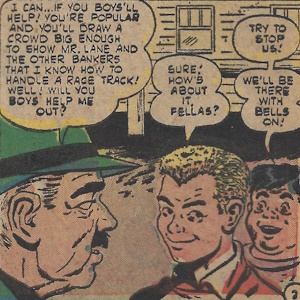
The Hot-Shots are winning a race. With their newly-streamlined car, the High-Gear Special (which I still think of as a Ship of Theseus for the Model TNT), the Hot-Shots have become an unmitigated success. They’re winning a lot and they draw a crowd to the tracks as well. That’s relevant because a man they know, Mr. Pettigrew, is opening a new racetrack over in Pineville. The thing is, he borrowed a bunch of money from the bank to finance this and now the bankers think he is too old to successfully operate it. They want to take over. If the opening race isn’t a success he will be ruined! Luckily for him, the High-Gear Hot-Shots agree to use their growing fame to help him out.
So that’s some nice understandable stakes quickly established. Exactly the kind of thing I have been asking for! If these stories want to live up to their promise of action, it’s helpful to set up a problem early and have all the racing be work toward solving it. That’s not too much to ask, is it? It’s not like I’m demanding these kids have their lives endangered by criminals or anything.
Oh, but then some criminals show up and full-on blackjack Drag. In much the way that the second story was about Rod, the Rich Kid of the group, this one is about Drag, the Big Kid of the group. He’s there in the car with Flash in the race at the beginning, and when they have the race at the new Pineville track, Drag helps out by working the ticket counter. That, of course, means he is the only obstacle between these criminals and their target.
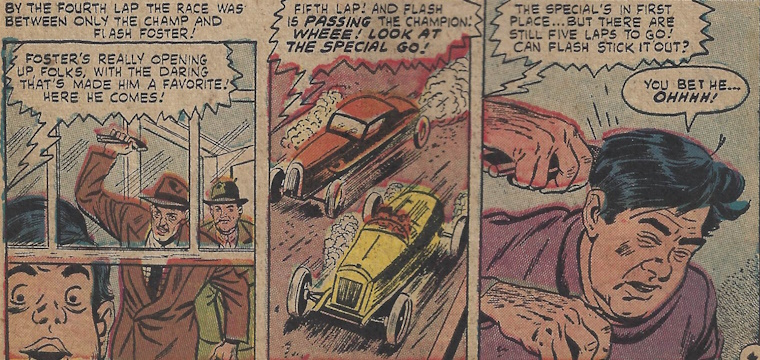
You can’t keep a good Drag down, though. He quickly runs out onto the track to flag down Flash so that they (the whole gang get in the car for some reason) can chase after the crooks and get Pettigrew’s money back. There’s an exciting chase scene ending when Flash can get the Special in front of the crooks’ car to cut them off. Seeing all this, the bankers realize the loyalty these kids have to Pettigrew, so they agree to let him keep the track. Hooray!
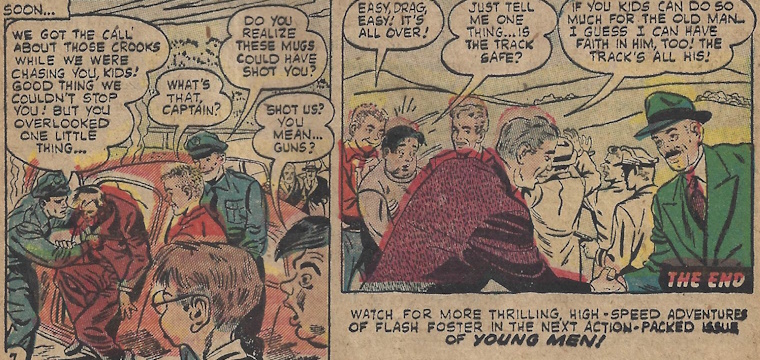
The realization that he’s in danger only catches up with Drag when the race is over. With this being Drag’s story, I wish that he and Flash had been alone in the car together during the chase, Rod and Hub don’t need to be there, but I do come out of this one liking Drag. Obviously his roll is to be the “fat one” of the group, but he’s never mocked for it (the only time I even remember it coming up is a in the first story where he is shown with a bunch of empty cups that used to have milkshakes or floats or whatever ’50s kids ate). In this, the story where he gets focus, he’s shown to be a little dumb, but nice and loyal and apparently tough (he shakes off that blackjacking before the crooks are very far away at all). That said, being fat is only his second-most important physical feature. His first is going like this:
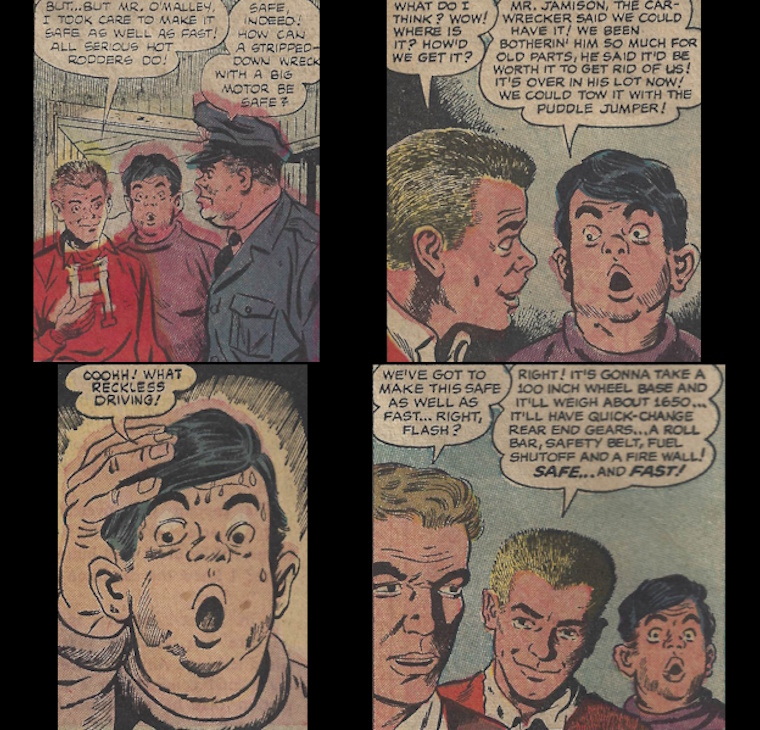
In all three issues, Drag has just been constantly gobsmacked. But he keeps going, like a High-Gear hero.
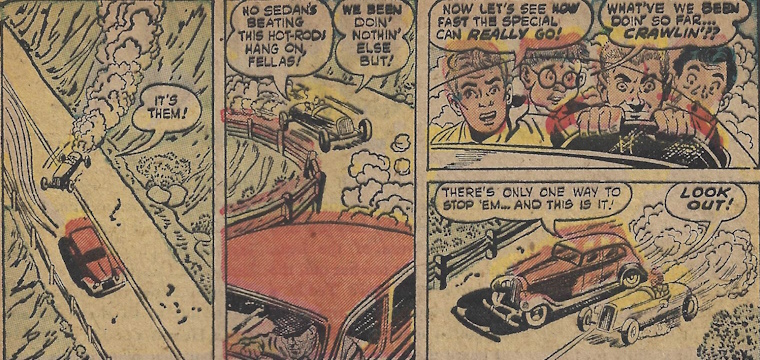
Then there’s the action. Of the three stories about this gang, this has the best action. There’s a story I’ve read about in a couple of Gene Colan interviews (one example is here for the curious) about a time when Stan Lee wanted Colan to draw a car chase. Colan did so, drawing a cool car chase that lasted multiple pages. Lee wasn’t happy! He said that Colan was wasting space, that the chase could have been done in a page. Fans wrote in saying they loved it, though. Giving an action scene time to be fun is important in comics.
The chase here runs for about three pages (more if we start it when Drag gets clocked upside the head). In a seven page story, that’s almost half of it! If some ’50s kid saw the cover to this comic and thought “I want to read an action-filled hot rod story” then this is a comic that would have given them one.
I can genuinely say that Flash Foster and his High-Gear Hot-Rods was finally getting somewhere as of this issue. If these characters had gone on, maybe they could have produced some great comics. We never got an issue about Hub. We never got to see them against a rival crew. Flash never got more personality. Sandra from the first issue never came back (this story doesn’t actually have a single female character). Given time, I think this could have grown into something.
Instead, in Young Men #24 the superheroes return. This doesn’t mark that genre’s permanent takeover of the medium quite yet. Captain America, Namor, and the Human Torch only return briefly, but it’s enough to derail our Hot-Shots. What a shame. They won me over and they got knocked down. Ain’t it always the way…
So that’s it for the Flash Foster stories, but I will be coming back to these issues of Young Men in the future. There’s three more features in this book that show what the non-superhero era of comics was like, and I look forward to all of them.

Ah, this is one of the few things I knew about when I started the show. David Vincent would be on his own until we got to the episode “The Believers” and then we’d have others joining the fight against the Invaders. We’re there! Finally David Vincent has a team! We witness a meeting of the team during which they talk all sorts of strategy and stuff, then several are shot dead by alien snipers and Vincent is captured. So it doesn’t go perfectly.
So the team doesn’t do much here, but they do explain this week’s game of Why Aren’t They Killing David Vincent While They Have The Chance? The aliens want Vincent alive this time so that they can learn the identities of the other members of the team. First they try to hypnotize Vincent into giving them the names, but it turns out that Vincent (and presumably the rest of the human crew) have given themselves hypnotic suggestions that make him reveal false info. Then they stage a fake rescue, on the assumption that Vincent would lead them to the team, but he sees through that one. So they imprison him in an underground base where he meets a human woman called Elyse, also a prisoner there, and then they escape for real.
So Vincent and Elyse are on the run, and they meet up with some of the team, but then those guys end up killed by the Invaders. Vincent puts it together and finds out that Elyse is working for the aliens! They claim to have captured her brother and will release him if she helps them, but Vincent makes her realize that her brother is already dead. She’s been used. Elyse feels bace that a bunch of people got killed because of her, but she’s willing to join the fight against the aliens if the team will have her. They vote, and they will.
My understanding is that most of the team depicted here (the ones who made it out alive, I mean) don’t show up in later episodes, but the man financing the group, a millionaire named Scoville, does. Honestly the presence of the group in this episode doesn’t change the show’s feeling much, but when Scoville continues to show up, let’s see how it feels.
I’ve noted that there have been a lot of people who have survived previous episodes with knowledge of the aliens, and you’d think someone of them would end up in this group (I also assume have been killed by Invaders cleaning up loose ends) but we don’t get that here. These are all new people to us. While this is done mostly for out-of-show reasons of casting of whatever, I also like to think that this underground anti-alien group is also operating in cells, to help prevent everyone from knowing everyone else. But we’ll never learn that in the show, so I get to just assume it is true. But anyway, my favourite thing in this one is at the beginning when the Invaders just start sniping people. It really shows what this war is like.
Latest SecGov Page: